


When We Teach People to Blame, We Train Division: A Nervous System Perspective for Clients and Clinicians


In today’s culture, emotionally charged labels get used casually — often without recognizing what they are actually reinforcing in the nervous system.
One example is the phrase “Trump Derangement Syndrome” (TDS). While the term itself is political and non-clinical, the behavioral pattern underneath it reveals something far more important: how easily humans externalize responsibility for their internal state.
This article is not about politics.
It’s about a nervous system perspective on blame, personal responsibility, and the ethical responsibility of therapy.
Because if someone is blaming a political figure for how they feel, they’re almost certainly doing the same thing in their relationships, families, workplaces, and communities.
What Externalization Really Is: A Nervous System Perspective on Blame
Externalization occurs when a person unconsciously assigns responsibility for their internal emotional state to something outside themselves.
The nervous system says:
“I feel unsafe, angry, overwhelmed — therefore someone else must be causing this.”
This reduces uncertainty in the short term, but it comes at a cost:
Loss of agency
Increased reactivity
Rigid thinking
Identity fusion
Chronic nervous system activation
The body stays locked in threat physiology instead of learning regulation.
Why This Pattern Damages Relationships
When someone believes their emotions are caused by others, they naturally:
Blame instead of self-regulate
Control instead of communicate
Polarize instead of stay curious
Escalate instead of repair
Avoid accountability
This pattern quietly erodes:
Trust
Emotional safety
Respect
Intimacy
Family cohesion
Politics may be the stage — but the nervous system pattern plays out everywhere.
The Clinical Concern
Therapy does not simply treat symptoms.
It trains nervous systems how to relate to:
Power
Responsibility
Safety
Authority
Difference
Conflict
When therapists unintentionally validate external blame, they reinforce:
Victim identity
External locus of control
Dependency on circumstances
Dysregulated attachment to narratives
Reduced emotional sovereignty
This keeps clients stuck — even when the intention is compassion.
True attunement supports regulation, differentiation, and agency — not agreement with projection.
Drama Triangle vs Empowerment
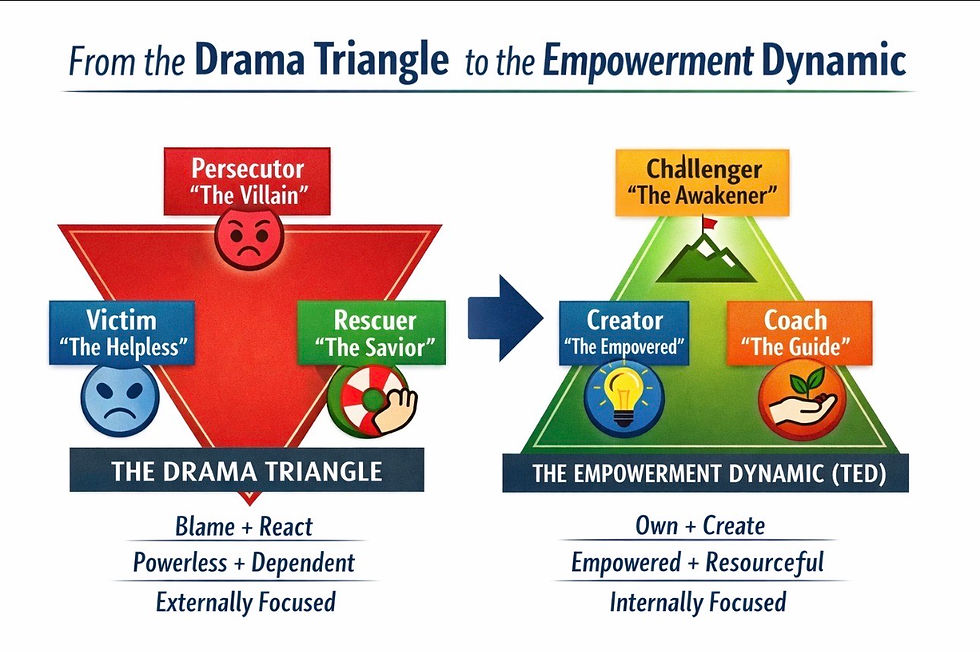
When blame becomes normalized, people fall into the Drama Triangle:
Victim
Rescuer
Persecutor
This reinforces powerlessness and division.
The Empowerment Dynamic shifts toward:
Creator
Coach
Challenger
This builds:
Responsibility
Regulation
Resilience
Emotional maturity
Secure relating
Empowerment is not comfort — it is capacity.
Why This Matters for Health
Chronic nervous system activation impacts:
Sleep and recovery
Hormonal balance
Blood sugar regulation
Immune function
Cognitive clarity
Mood stability
Inflammation
A nervous system trained in threat cannot heal efficiently.
This is not philosophical — it’s physiological.
This Is Not About Silencing Beliefs
Strong beliefs and healthy disagreement are part of a functional society.
What destabilizes individuals and families is:
Identity fusion
Threat-based nervous systems
Lack of emotional responsibility
Inability to tolerate difference
Loss of curiosit
Regulation allows disagreement without dehumanization.
The Leadership Question
Instead of asking:
“Who is causing this?”
A healthier question becomes:
“What is my nervous system responsible for regulating inside me?”
That question restores agency, maturity, and sovereignty — personally and collectively.
Awareness is the first step — but it’s not where change happens.
Regulation, responsibility, and nervous system capacity are skills that can be learned and practiced.
In my next post, How to Retrain Responsibility in the Nervous System, I’ll walk through practical ways to shift out of blame-based patterns and build internal regulation, emotional sovereignty, and healthier relational dynamics.
If this conversation resonates, check back soon for the follow-up.
Gentle Disclaimer
This article is educational and not a substitute for individualized medical or mental health care.
Legal Disclaimer
I am Tiffany Bays, MS, LPC, CMNCS, a Licensed Professional Counselor, Certified Mental Health & Nutrition Clinical Specialist, Certified Breathwork Practitioner, Master Practitioner of NLP, MER & Hypnosis, trauma-trained, and holistic psychotherapist. I am not a medical doctor. The information provided here and in the accompanying document is for educational and informational purposes only. It is not intended to diagnose, treat, cure, or prevent any medical condition. By choosing to use this information, you acknowledge and accept full responsibility for your own health decisions. Please consult a qualified medical professional before making any changes to your healthcare routine.


Comments